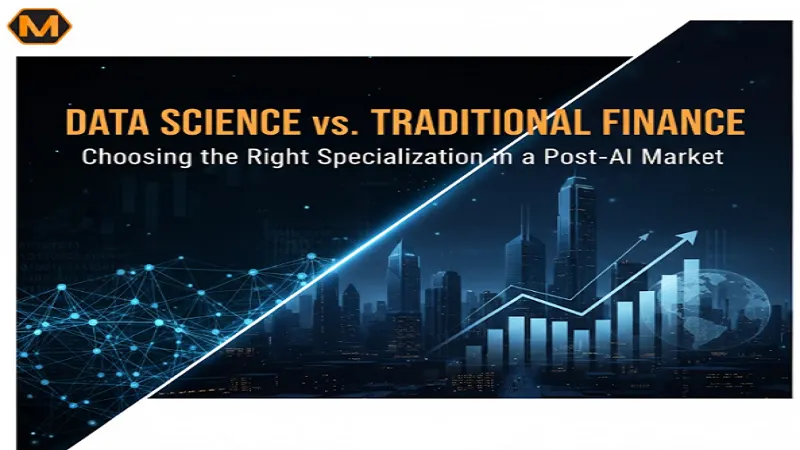

The career landscape for college students has shifted dramatically as we move through 2026. Only a few years ago, a student graduating with a degree in finance could expect a steady path of spreadsheets, manual auditing, and predictable corporate ladders. Today, the “Post-AI Market” has turned those old expectations upside down. As a student standing at the crossroads of your education, you are likely asking: Should I stick with the prestige and strategic depth of Traditional Finance, or should I jump into the high-tech, algorithm-driven world of Data Science? The answer isn’t just about which job pays more—it’s about which one fits your cognitive style and your long-term goals in a world where AI agents now handle the “busy work” of both sectors.
Choosing between these two paths requires a deep understanding of how global markets operate today. If you feel overwhelmed by the technical jargon of your university courses or the sudden shift toward algorithmic trading, seeking Finance Assignment Help from the expert team at myassignmenthelp can provide the clarity needed to master these complex concepts. Traditional finance is no longer just about balance sheets; it has integrated with digital asset tokenization and real-time regulatory compliance. Whether you are analyzing the fiscal policy of Asian markets or the liquidity of a neobank, the foundational skills remain the same, but the tools have evolved into something much more powerful, automated, and fast-paced than ever before.
The New Face of Traditional Finance
Traditional finance in 2026 is often called “Finance 2.0.” It’s no longer about sitting in a cubicle doing manual data entry or basic reconciliation. Instead, finance professionals are now the “navigators” of AI systems. Your job is to look at the predictions made by a machine and decide if they make sense in the real-world context of human behavior and geopolitical shifts. For example, an AI might suggest a massive investment in Southeast Asian bonds based on data trends, but a human finance expert knows that a sudden change in local political leadership or a social movement might make that move incredibly risky.
College students entering this field today need to be comfortable with “Financial Health-as-a-Service” (FHaaS) and ESG (Environmental, Social, and Governance) reporting. These are the areas where human judgment is still king. While a robot can calculate a profit margin in milliseconds, it cannot yet fully grasp the ethical implications of a company’s carbon footprint or the social impact of a new micro-lending app in rural Indonesia. The “Traditional” finance student is now a strategist who uses AI to validate their intuition.
The Exploding World of Data Science
On the other side of the coin is Data Science. This is the “engine room” of the modern economy. If the finance professional is the navigator, the data scientist is the one building the ship’s engine. In a post-AI market, data scientists are moving away from just “writing code” and moving toward “teaching machines.” They build the Agentic AI systems that can autonomously manage credit scoring, fraud detection, and high-frequency trading without human intervention.
For students who love patterns, puzzles, and logic, this is a dream career. You aren’t just looking at money; you are looking at the digital footprint of human behavior. You might spend your day analyzing how Gen Z investment habits change when a new “WealthTech” app launches or figuring out how to protect a bank’s data using quantum-resistant cryptography. It is a field of constant invention where the rules are being written as you go. You are the architect of the systems that will eventually dictate how money flows around the world.
The Convergence of Skills in 2026
What many students realize halfway through their degree is that these two fields are actually merging. You can no longer be a “pure” finance major without knowing how to read a basic Python script, and you can’t be a “pure” data scientist without understanding the basics of market liquidity and macroeconomics. This overlap is where the most lucrative jobs are found. Companies in the Asian Fintech sector are looking for “Bilingual” graduates—those who can speak the language of the boardroom and the language of the server room.
Before you reach the final stage of your academic journey, many students find that using professional MBA Dissertation Writing Services helps them synthesize these high-level tech trends into a winning final paper that impresses both tech recruiters and bank managers. Having a solid mentor to guide your research on topics like “Decentralized Stablecoins” or “Hyper-Personalized Banking” ensures that you don’t just graduate, but you graduate as a thought leader in your chosen niche with a portfolio that proves your expertise.
Key Differences in Daily Life and Career Growth
To help you decide, let’s look at the actual work you will do. In Traditional Finance, your day is filled with communication. You are explaining risks to stakeholders, managing portfolios, and looking at the “Why” behind market movements. In Data Science, your day is focused on the “How.” You are cleaning massive datasets, training models, and ensuring that the AI isn’t hallucinating its results.
| Feature | Traditional Finance (2.0) | Data Science (Post-AI) |
| Primary Tool | AI Copilots & Advanced Excel | Python, SQL, and ML Models |
| Main Focus | Risk, Strategy, & Valuation | Algorithms, Patterns, & Data Quality |
| Output | Investment Reports & Strategy | Predictive Models & AI Systems |
| Human Element | High (Client relationships) | Medium (Technical translation) |
The Academic Challenge for College Students
The transition from 12th grade to a high-level university program in either of these fields is a massive jump. Universities are now teaching “Computational Finance,” which combines calculus with coding. Students often struggle because they are expected to be good at math and good at writing simultaneously. This is why many successful graduates utilize academic support systems to help them balance the heavy workload. Whether it’s a complex case study on a Singaporean neobank or a technical paper on algorithmic bias, the pressure to perform is higher than it was for previous generations.
The Role of AI in Your Career Longevity
Many students worry that AI will replace their jobs before they even graduate. In reality, AI is replacing tasks, not jobs. If your job is just to move data from one sheet to another, yes, you should be worried. But if your job is to interpret data, solve problems, and make decisions, AI is actually your best friend. It removes the boring parts of the job, allowing you to focus on high-value work. In Traditional Finance, AI handles the math so you can focus on the relationship. In Data Science, AI handles the basic syntax so you can focus on the architecture.
How to Build a Hybrid Portfolio
If you want to be a top-tier candidate in 2026, don’t just choose one. Even if you major in Finance, take a minor in Data Science. If you major in Data Science, make sure you understand the “Time Value of Money.” Employers want to see projects. For a finance student, this might be a mock portfolio managed with an AI tool. For a data science student, it might be a fraud-detection algorithm built for a fictional peer-to-peer lending site. These projects prove that you can apply classroom knowledge to real-world Fintech problems.
Navigating the Post-AI Job Market in Asia
The Asian market is currently the fastest-growing Fintech hub in the world. From the digital payment systems in India to the crypto-hubs in Hong Kong, the demand for “Post-AI” talent is massive. However, these companies are no longer looking for generalists. They want specialists who understand the local regulations and the unique cultural behaviors of Asian consumers. A student who understands how “Super Apps” like WeChat or Grab work from both a financial and a data perspective will be much more valuable than someone who only knows the theoretical models used in Western textbooks.
Final Thoughts: Which Path is Yours?
Ultimately, the choice depends on where you find your “flow.” If you get excited by the high-stakes environment of a trading floor (even a virtual one) and you enjoy the art of negotiation and strategy, Traditional Finance is your home. It offers a path to leadership, executive roles, and a deep understanding of how power and money move globally. It is a career of influence.
However, if you find peace in the logic of a clean line of code and you want to be the one who builds the future rather than just managing it, Data Science is the path for you. It offers the freedom to work across different industries—from healthcare to finance—and puts you at the very center of the AI revolution. It is a career of creation.
No matter which path you choose, remember that education is a marathon, not a sprint. Use every tool at your disposal, from online communities to professional writing services, to ensure that your academic record is as strong as your technical skills. The post-AI market is competitive, but for a student who is prepared, it offers opportunities that were unimaginable just a decade ago.
Frequently Asked Questions
What is the main difference between data science and traditional finance roles today?
In the current market, traditional finance focuses on human-led strategy, risk assessment, and high-level decision-making using AI tools for support. Data science, meanwhile, is centered on building the actual technical infrastructure, algorithms, and predictive models that power those financial systems.
Do I need to know how to code to work in the modern finance sector?
While you don’t need to be a software engineer, having a basic understanding of programming languages like Python or SQL is becoming essential. Modern finance professionals must be able to interpret data-driven results and communicate effectively with the technical teams building the tools.
Which career path offers better long-term security in an AI-driven economy?
Both paths offer strong security if you focus on high-value skills that machines cannot easily replicate. For finance, this means complex problem-solving and relationship management; for data science, it means creative system architecture and ensuring the ethical accuracy of AI models.
Can I switch from a finance major to a data science career later on?
Yes, the fields are increasingly overlapping. Many professionals start in finance and transition into data roles by taking specialized certifications in machine learning and data analytics. The reverse is also common for technical experts who gain deep knowledge of market mechanics.